


Choosing the correct screen printing squeegee hardness is one of the most important decisions in any screen printing process. While factors such as mesh count, ink type, and printing speed all influence the final result, the hardness of the squeegee directly affects ink transfer, print sharpness, and production efficiency.
Whether you’re printing textiles, ceramics, glass, electronics, or plastic products, selecting the right polyurethane (PU) squeegee hardness can help you achieve cleaner prints, reduce waste, and extend the life of both the squeegee and the screen.
This guide explains the differences between 60, 70, 80, and 90 Shore A screen printing squeegees, helping you choose the best option for your application.
What Does Shore Hardness Mean?
The hardness of a screen printing squeegee is measured using the Shore A scale, which indicates how soft or hard the polyurethane blade is.
- Lower Shore A values = Softer, more flexible squeegees
- Higher Shore A values = Harder, more rigid squeegees
A softer silk screen squeegee bends more easily under pressure, allowing more ink to pass through the mesh. A harder squeegee flexes less, resulting in thinner ink deposits and sharper image definition.
Screen Printing Squeegee Hardness Comparison
| Hardness | Flexibility | Ink Deposit | Print Detail | Typical Applications |
|---|---|---|---|---|
| 60 Shore A | High | High | Moderate | Textile printing, rough surfaces |
| 70 Shore A | Medium | Medium | Good | General screen printing |
| 80 Shore A | Low | Low | Excellent | Glass, plastics, graphics |
| 90 Shore A | Very Low | Very Low | Maximum | PCB, electronics, precision printing |
60 Shore A: Best for Heavy Ink Coverage
A 60 Shore A polyurethane squeegee is soft and highly flexible. It bends easily during printing, allowing a generous amount of ink to transfer through the screen.
Recommended Applications
- Textile printing
- Dark garments
- Thick specialty inks
- Printing on textured surfaces
- Decorative products
Advantages
- Higher ink deposit
- Better coverage on uneven materials
- Suitable for absorbent substrates
Considerations
Because soft squeegees flex more, they may produce slightly less defined edges on fine-detail artwork and typically wear faster under heavy production.
70 Shore A: The Most Versatile Choice
The 70 Shore A screen printing squeegee is considered the industry standard for many commercial applications.
It offers an excellent balance between flexibility, durability, and print quality, making it the preferred choice for many printing shops.
Recommended Applications
- General graphics
- Packaging
- Signage
- Plastic products
- Promotional items
Advantages
- Balanced ink transfer
- Good print resolution
- Long service life
- Suitable for most inks
For many printers, a 70 Shore A blade is the safest choice when one squeegee must handle multiple jobs.
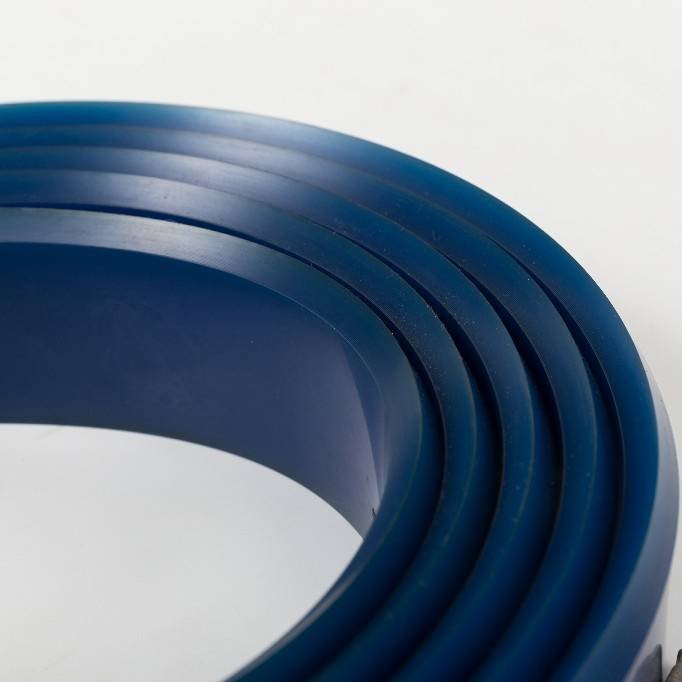
80 Shore A: Better Precision and Sharper Images
An 80 Shore A polyurethane squeegee is significantly firmer than a standard 70 Shore A blade.
Because it bends less during printing, it deposits less ink while producing cleaner edges and finer details.
Recommended Applications
- Glass printing
- Ceramic decoration
- Plastic panels
- Industrial graphics
- High-resolution artwork
Advantages
- Excellent edge definition
- More consistent ink control
- Reduced ink consumption
- Longer wear life
This hardness is commonly selected for industrial printing where image quality and production consistency are priorities.
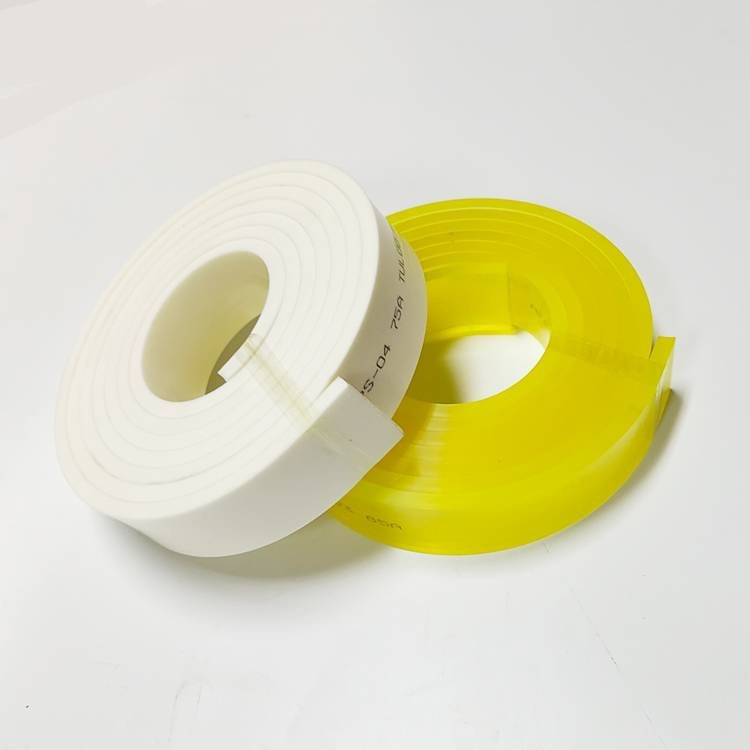
90 Shore A: Maximum Accuracy for Precision Printing
The 90 Shore A screen printing squeegee is designed for highly specialized applications where precision is critical.
Its minimal flexibility allows exceptional control over ink transfer, making it ideal for printing extremely fine features.
Recommended Applications
- PCB manufacturing
- Printed electronics
- Solar cells
- Membrane switches
- High-precision industrial printing
Advantages
- Outstanding dimensional accuracy
- Very fine line reproduction
- Excellent wear resistance
- Stable performance in automated production lines
Because these blades transfer less ink, they are generally not recommended for textile printing or applications requiring heavy ink deposits.
Single, Dual, or Triple Durometer?
Besides choosing the hardness, manufacturers often offer different hardness constructions.
Single Durometer
The entire blade has one consistent hardness.
Best for:
- Standard printing applications
- General production
Dual Durometer
A softer body is combined with a harder printing edge.
Benefits include:
- Improved flexibility
- Better operator control
- Longer service life
- More consistent pressure distribution
Triple Durometer
Features a soft center sandwiched between two harder outer layers.
Advantages include:
- Excellent stability
- Reduced blade deflection
- High-speed printing performance
- Superior print consistency
Triple-durometer squeegees are commonly used in demanding industrial environments where productivity and repeatability are essential.
How to Choose the Right Hardness
When selecting the best screen printing squeegee, consider the following factors:
Substrate
Smooth materials such as glass and electronics generally require harder squeegees, while textiles benefit from softer blades.
Ink Type
Thicker inks often require softer squeegees to achieve adequate coverage, while UV and precision inks perform well with harder blades.
Mesh Count
Higher mesh counts are typically paired with harder squeegees for fine-detail printing, while lower mesh counts work well with softer blades for greater ink transfer.
Print Detail
The finer the artwork, the harder the squeegee should generally be.
Quick Selection Guide
Application | Recommended Hardness |
| Textile Printing | 60–70 Shore A |
| Packaging | 70 Shore A |
| General Commercial Printing | 70 Shore A |
| Plastic Printing | 70–80 Shore A |
| Glass Printing | 80 Shore A |
| Ceramic Printing | 80 Shore A |
| Signage | 70–80 Shore A |
| PCB Printing | 90 Shore A |
| Electronics | 90 Shore A |
| Solar Cell Printing | 90 Shore A |
Frequently Asked Questions
Is a harder screen printing squeegee always better?
No. A harder squeegee provides finer detail and transfers less ink, but it may not be suitable for textiles or textured surfaces where greater ink coverage is needed.
Which hardness is best for textile printing?
For most textile applications, 60 to 70 Shore A provides the best balance between flexibility and ink transfer.
Which hardness is best for glass printing?
Most glass printing operations use 80 Shore A squeegees because they offer excellent print definition and controlled ink deposition.
How often should a PU squeegee be replaced?
The replacement interval depends on production volume, ink chemistry, printing pressure, and maintenance practices. Regular inspection and proper storage can significantly extend service life.
Conclusion
There is no universal answer to whether 60, 70, 80, or 90 Shore A is the best screen printing squeegee hardness. The ideal choice depends on your substrate, ink, screen mesh, and desired print quality.
As a general rule:
- 60 Shore A for high ink coverage
- 70 Shore A for everyday commercial printing
- 80 Shore A for industrial graphics and glass
- 90 Shore A for PCB and precision electronics
Understanding these differences will help you select the right silk screen squeegee for your production process, improving print consistency while reducing downtime and operating costs.
Whether you need a versatile 70 Shore A blade or a high-precision 90 Shore A solution, PENGDE can help you find the right squeegee for your application. Please contact us at
pengde2@pengde-pu.com.

